
How Much Does It Cost to Clear an Acre of Land?
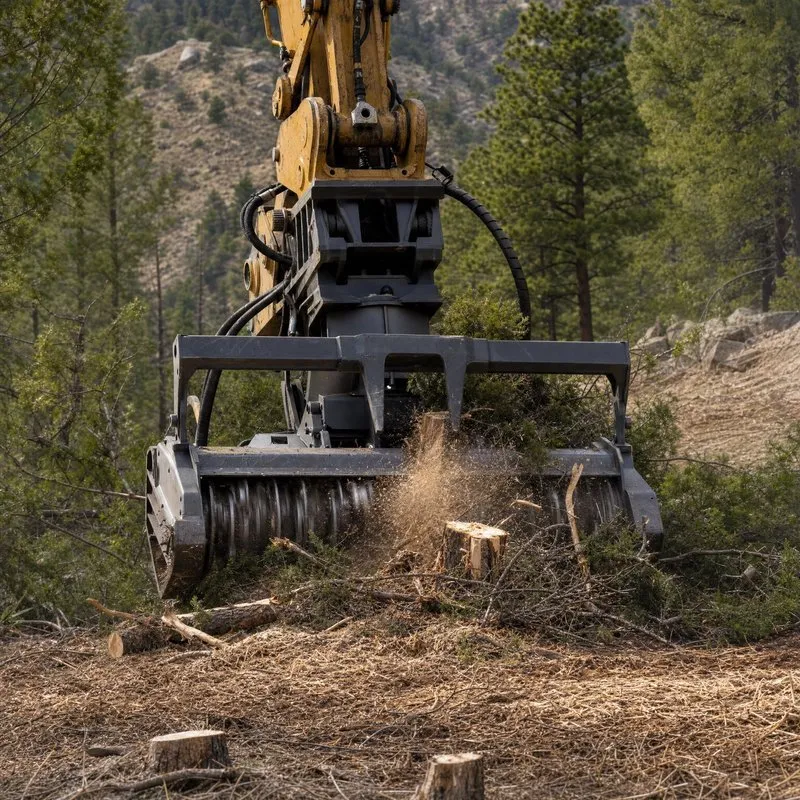
Clearing one acre of land usually costs between $1,200 and $12,000. Most standard wooded acres land between $2,500 and $6,000. The low end is grass, brush and a few saplings. The high end is a thick stand of trees where every stump has to come out so a house, driveway or septic system can go in.
Those are typical national ranges, not my prices. On mountain ground in Teller and Park counties the same acre can cost more, mostly because of rock and slope. Below I break down what moves the number, what a half acre and a 20-acre parcel look like, and the add-ons that catch people off guard.
What sets the price of clearing an acre
Four things decide most of the bill.
How much is growing on it. Vegetation density matters more than lot size. A half acre of big ponderosa and Douglas fir can cost more to clear than a full acre of scrub oak and grass.
What you are clearing it for. Clearing a fire break or opening up a view is one job. Clearing a building pad is another. A house, a driveway or a leach field needs every stump and root ball out of the ground, because buried roots rot and the ground settles under whatever you build on top.
Rock, slope and access. Granite near the surface means a hydraulic breaker and more machine hours. Steep ground slows every pass. A narrow switchback driveway can limit which machine fits on the lot at all.
Where the slash goes. Chipping or mulching it on site is cheapest. Hauling it off adds trucking and dump fees. Burning is often limited or banned during fire restrictions, so don’t build your budget around a burn pile.
Typical cost per acre by vegetation
These are the ranges you will see in national cost data, and they match what a clean, accessible lot runs:
- Grass, brush and saplings (under about 3 inches): $1,200 to $2,500 per acre. A forestry mulcher or skid steer moves through this fast, often in a day.
- Thick undergrowth and small trees (up to about 12 inches): $2,500 to $4,000 per acre. More machine time, more stumps, often a second pass.
- Heavily wooded, cleared but not build-ready: $4,000 to $6,000 per acre. The trees come down and the debris gets handled, but the ground is not ready for a foundation.
- Construction-ready, with stumps pulled and the pad roughed in: $6,000 to $12,000 per acre. This is excavator work: trees pushed, root balls pulled, the ground shaped so the next trade can start.
Rocky ground can push any of these higher. I’d rather tell you that before the machine shows up than after.
What it costs to clear a half acre of wooded land
A half acre doesn’t cost half as much as an acre. Getting a machine to your property costs the same whether it works four hours or four days, so small jobs carry more of that cost per square foot. A fair way to think about it: a half acre usually runs 50 to 70 percent of what a full acre of the same ground would.
That puts a wooded half acre at roughly:
- Lightly wooded: about $700 to $1,500
- Moderately wooded, with a handful of mature trees: about $1,500 to $3,000
- Heavily wooded: about $2,500 to $4,500
- Cleared and ready for a house pad: about $4,000 to $7,500 before grading, excavation and septic
That last line is where most mountain homesites sit. A half acre is often the whole footprint you need cleared: the house, the driveway, the septic tank and field, and room around the house for defensible space. The rest of the lot can stay wooded.
What it costs to clear 20 acres
Big parcels get a lower rate per acre because the trucking and setup get spread across more ground. Typical national numbers for 20 acres:
- Light brush and sparse trees: $1,200 to $2,000 per acre, about $24,000 to $40,000 total
- Mixed forest: $2,000 to $3,500 per acre, about $40,000 to $70,000 total
- Dense, mature timber: $3,500 to $5,000 or more per acre, about $70,000 to $100,000 or more total
Here’s the correction most cost guides miss. Very few people with 20 acres in the mountains need all 20 cleared. If you are building one house, you need the homesite, the driveway in, the septic area and defensible space thinned around the house. That might be one to three acres of real clearing plus selective thinning on the rest. Pricing all 20 acres to a construction standard is how a $15,000 job turns into a $100,000 quote.
If the goal is fire mitigation or pasture across the whole parcel, forestry mulching is usually the right tool. It grinds trees and brush in place and leaves the chips as ground cover, with no haul-off.
Clearing methods and what each one leaves behind
Forestry mulching grinds trees, brush and stumps down to chips in one pass. It is fast and leaves the topsoil mostly in place. The catch: stumps get ground at the surface, but the roots stay in the ground. That’s fine for fire breaks, trails and thinning. It is not fine under a foundation, a driveway base or a leach field.
Dozer clearing pushes trees over, roots and all, and piles them. It moves a lot of material quickly on open ground. It also scrapes up and buries topsoil, so expect grading afterward.
Excavator clearing costs more per acre but gives the most control. The excavator pulls root balls out whole, picks what stays and what goes, and works on slopes and around rock where a dozer struggles. For a homesite in the mountains this is usually how I’d do it, because the same machine can go straight into the site prep and excavation that comes next.
Plenty of jobs use two methods: mulch the areas you are thinning, then pull stumps with the excavator where the house, driveway and septic go.
Add-ons to budget for
The clearing number gets the trees off the ground. It doesn’t make the site buildable. Ask about each of these:
- Stump removal. Grinding usually runs $100 to $400 per stump, depending on diameter. Full extraction is what a building pad needs and is often priced into excavator time.
- Grading. Cleared ground is rough and uneven. Rough grading sets slope and drainage; finish grading sets the final elevations for a slab or driveway. National ranges run $1,000 to $5,000 per acre. See grading for how I approach it.
- Debris haul-off. Often $300 to $1,200 on a small job, or a few hundred dollars per truckload. Chipping on site avoids it.
- Rock. There is no honest flat number. Some lots have none. Some have a granite shelf a foot down. A breaker on the excavator handles most of it, but it adds hours.
- Permits and erosion control. Clearing a larger area, especially near a creek, can trigger county grading rules and silt fence requirements. Construction that disturbs an acre or more can also need a state stormwater permit.
Mountain conditions that change the math
Most of my work is in Teller and Park counties and the Front Range foothills, and a few things show up here that flatland cost guides ignore.
The soil is mostly decomposed granite, which digs easily until it doesn’t. Boulders and outcrops are common, and they are the biggest reason a mountain acre costs more than a national average.
Slope slows everything. On steep lots the machine has to work across the hill, and some ground needs a smaller tracked machine instead of a big one.
The timber usually isn’t worth much. Guides written for hardwood country tell you to sell your oak and walnut to a sawmill first. Here it is mostly pine, fir and aspen, a lot of it beetle-killed, and it is worth firewood more often than a timber check.
If you are putting in a septic system, keep machines off the area where the leach field will go. Running heavy equipment over it packs the soil, and packed soil can change how the field is designed. I plan the clearing around the septic system layout for that reason.
How to get a clearing bid that holds
- Know your acreage and roughly where the house, driveway and septic will go. “I want to build” is a different scope than “clean it up.”
- Take photos of the thickest part of the lot. Note tree sizes and any visible rock.
- Ask for one bid that covers clearing, stumps, slash and rough grading, not just felling.
- Ask who handles permits.
- Ask what happens if they hit rock or buried junk.
A bid that only covers cutting trees is how budgets blow up. When I walk a site, I put the full scope in writing within 24 hours, so you can compare it side by side with anyone else’s.
Common questions
How long does it take to clear an acre?
Anywhere from one day for light brush to a week or more for dense trees with every stump pulled. I break it down by acreage in how long it takes to clear an acre with an excavator.
Does land clearing include stump removal?
Not automatically. Many quotes cover cutting and removing what is above ground. Ask whether stumps are ground or pulled, and to what depth.
Can I clear my own land to save money?
Light brush and small trees on a small lot, yes, with a rented brush cutter or skid steer. Big trees, slopes and anything that needs to be build-ready are where DIY gets expensive and dangerous. I wrote more about that in clearing land yourself.
How much does it cost to clear land and put in a driveway?
National numbers for clearing an acre plus a gravel driveway run roughly $5,000 to $15,000 combined. On a mountain lot, driveway length, grade and culverts matter more than the clearing. Doing both with one operator saves a second mobilization.
What happens to the trees after clearing?
They get mulched or chipped on site, cut for firewood, hauled off, or burned where it is allowed and safe. Ask for the cost of each before work starts.
If you have a lot that needs clearing, call or text me at (719) 280-4141. I’ll walk it, tell you what it actually needs, and you’ll have the number in writing within 24 hours. More on what I do at land clearing and tree removal.